

Skip to content
Frankenstein Protocol™Join

Independent AI software project

Frankenstein Protocol™

Activate The Machine

A premium AI automation and agentic software framework for builders who need controlled execution, auditable logic, and operator-grade command over machine workflows.

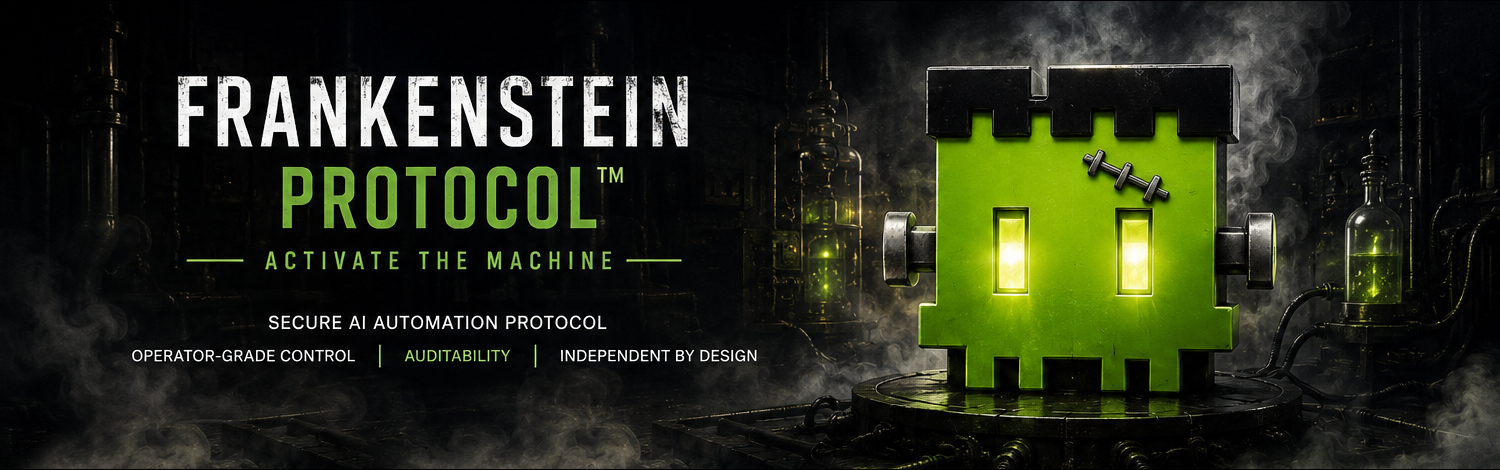
Frankenstein Protocol, Activate The Machine banner.
Access: ScopedLogic: AuditedControl: Manual

What it is

A serious framework for controlled AI automation.

Frankenstein Protocol™ is positioned as a premium automation layer for agentic software: a place to define what machines may do, how they are observed, and when a human operator must step in.

Define

Map goals into explicit protocol logic.

Constrain

Set permissions, tools, and execution limits.

Activate

Run workflows with visible machine state.

Review

Inspect activity, outputs, and intervention points.

Core modules

Protocol surfaces built for operators and developers.

Each module is designed around narrow access, clear state, and usable controls instead of black-box automation theater.

01

Agentic Automation

Coordinate multi-step AI workflows with operator oversight, deliberate scope, and repeatable execution paths.

02

Secure Infrastructure

Design automation surfaces around isolated environments, minimal access, and infrastructure that can be inspected.

03

Protocol Logic

Define task rules, escalation points, constraints, and execution boundaries before the machine starts moving.

04

Monitoring & Control

Track active runs, intervention points, and state changes through a command surface built for human supervision.

05

Developer Tools

Give builders practical primitives for connecting agents, tools, prompts, policies, and deployment workflows.

06

Audit Trails

Record decisions, tool calls, permission grants, and run metadata so activity can be reviewed after execution.

Security first

The machine starts inside a bounded control room.

The protocol philosophy favors local-first design where applicable, no unnecessary access, user-controlled permissions, auditability, transparency, and decisive stop controls.

  • Local-first design where applicable
  • No unnecessary access
  • User-controlled permissions
  • Auditability by default
  • Transparent system behavior
  • Kill-switch philosophy

Roadmap

A staged path from signal to ecosystem.

The early roadmap is intentionally focused: establish the brand, validate the protocol privately, then release developer tools only when the operating model is hardened.

  1. Phase 1

    Active

    Brand site + waitlist

    Launch the public identity, establish the protocol narrative, and collect early operator interest.

  2. Phase 2

    Next

    Private beta

    Validate controlled automations with a small group of builders, operators, and technical partners.

  3. Phase 3

    Planned

    Developer tools

    Release practical interfaces for protocol definitions, integrations, test runs, and deployment handoffs.

  4. Phase 4

    Planned

    Protocol ecosystem

    Expand into reusable modules, community patterns, documented extensions, and hardened integrations.

Waitlist

Request early access to the protocol.

Join the early operator list for updates on the private beta, developer tools, and protocol release milestones.

Ready for a future API or form provider connection.